

SSH-Login hängt beim Arbeiten von zu Hause: Ein TOS-Problem des Routers
Ich hatte ein wirklich ärgerliches Problem mit SSH-Sitzungen, als ich von zu Hause an meinem Ubuntu-System gearbeitet habe. Ich habe es auf meinen BT HomeHub 5-Router eingegrenzt, habe mir aber die ‘exakte’ Ursache nicht genauer angesehen – mein Fehler! Über meine 4G-Handyverbindung hat alles einwandfrei funktioniert 🙂 Ich brauchte nur einen kleinen Vorwand, um mir einen neuen Router zu kaufen und mich vom restriktiven HomeHub zu verabschieden.
Ich habe mich für den TP-Link Archer VR2600 entschieden – zu der Zeit gab es gute Bewertungen, aber…… ich hatte genau das gleiche Problem.
Falls also jemand anderes Probleme beim Einloggen von zu Hause (oder einem NAT-standort) mit OpenSSH hat und beim Einloggen den folgenden Fehler ‚hängen‘ bekommt—
grazzer@grazzer-dev:~$ ssh -vvv -i Dev/DevOpsPipeline_SSH_Keypair.pem ubuntu@62.60.47.230
OpenSSH_7.2p2 Ubuntu-4ubuntu2.2, OpenSSL 1.0.2g  1 Mar 2016
debug1: Reading configuration data /home/grazzer/.ssh/config
debug1: Reading configuration data /etc/ssh/ssh_config
debug1: /etc/ssh/ssh_config line 19: Applying options for *
debug2: resolving "62.60.47.230" port 22
debug2: ssh_connect_direct: needpriv 0
debug1: Connecting to 62.60.47.230 [62.60.47.230] port 22.
debug1: Connection established.
debug1: key_load_public: No such file or directory
debug1: identity file Dev/DevOpsPipeline_SSH_Keypair.pem type -1
debug1: key_load_public: No such file or directory
debug1: identity file Dev/DevOpsPipeline_SSH_Keypair.pem-cert type -1
debug1: Enabling compatibility mode for protocol 2.0
debug1: Local version string SSH-2.0-OpenSSH_7.2p2 Ubuntu-4ubuntu2.2
debug1: Remote protocol version 2.0, remote software version OpenSSH_7.2p2 Ubuntu-4ubuntu2.2
debug1: match: OpenSSH_7.2p2 Ubuntu-4ubuntu2.2 pat OpenSSH* compat 0x04000000
debug2: fd 3 setting O_NONBLOCK
debug1: Authenticating to 62.60.47.230:22 as 'ubuntu'
debug3: hostkeys_foreach: reading file "/home/grazzer/.ssh/known_hosts"
debug3: record_hostkey: found key type ECDSA in file /home/grazzer/.ssh/known_hosts:9
debug3: load_hostkeys: loaded 1 keys from 62.60.47.230
debug3: order_hostkeyalgs: prefer hostkeyalgs: ecdsa-sha2-nistp256-cert-v01@openssh.com,ecdsa-sha2-nistp384-cert-v01@openssh.com,ecdsa-sha2-nistp521-cert-v01@openssh.com,ecdsa-sha2-nistp256,ecdsa-sha2-nistp384,ecdsa-sha2-nistp521
debug3: send packet: type 20
debug1: SSH2_MSG_KEXINIT sent
debug3: receive packet: type 20
debug1: SSH2_MSG_KEXINIT received
debug2: local client KEXINIT proposal
debug2: KEX algorithms: curve25519-sha256@libssh.org,ecdh-sha2-nistp256,ecdh-sha2-nistp384,ecdh-sha2-nistp521,diffie-hellman-group-exchange-sha256,diffie-hellman-group-exchange-sha1,diffie-hellman-group14-sha1,ext-info-c
debug2: host key algorithms: ecdsa-sha2-nistp256-cert-v01@openssh.com,ecdsa-sha2-nistp384-cert-v01@openssh.com,ecdsa-sha2-nistp521-cert-v01@openssh.com,ecdsa-sha2-nistp256,ecdsa-sha2-nistp384,ecdsa-sha2-nistp521,ssh-ed25519-cert-v01@openssh.com,ssh-rsa-cert-v01@openssh.com,ssh-ed25519,rsa-sha2-512,rsa-sha2-256,ssh-rsa
debug2: ciphers ctos: chacha20-poly1305@openssh.com,aes128-ctr,aes192-ctr,aes256-ctr,aes128-gcm@openssh.com,aes256-gcm@openssh.com,aes128-cbc,aes192-cbc,aes256-cbc,3des-cbc
debug2: ciphers stoc: chacha20-poly1305@openssh.com,aes128-ctr,aes192-ctr,aes256-ctr,aes128-gcm@openssh.com,aes256-gcm@openssh.com,aes128-cbc,aes192-cbc,aes256-cbc,3des-cbc
debug2: MACs ctos: umac-64-etm@openssh.com,umac-128-etm@openssh.com,hmac-sha2-256-etm@openssh.com,hmac-sha2-512-etm@openssh.com,hmac-sha1-etm@openssh.com,umac-64@openssh.com,umac-128@openssh.com,hmac-sha2-256,hmac-sha2-512,hmac-sha1
debug2: MACs stoc: umac-64-etm@openssh.com,umac-128-etm@openssh.com,hmac-sha2-256-etm@openssh.com,hmac-sha2-512-etm@openssh.com,hmac-sha1-etm@openssh.com,umac-64@openssh.com,umac-128@openssh.com,hmac-sha2-256,hmac-sha2-512,hmac-sha1
debug2: compression ctos: none,zlib@openssh.com,zlib
debug2: compression stoc: none,zlib@openssh.com,zlib
debug2: languages ctos:
debug2: languages stoc:
debug2: first_kex_follows 0
debug2: reserved 0
debug2: peer server KEXINIT proposal
debug2: KEX algorithms: curve25519-sha256@libssh.org,ecdh-sha2-nistp256,ecdh-sha2-nistp384,ecdh-sha2-nistp521,diffie-hellman-group-exchange-sha256,diffie-hellman-group14-sha1
debug2: host key algorithms: ssh-rsa,rsa-sha2-512,rsa-sha2-256,ecdsa-sha2-nistp256,ssh-ed25519
debug2: ciphers ctos: chacha20-poly1305@openssh.com,aes128-ctr,aes192-ctr,aes256-ctr,aes128-gcm@openssh.com,aes256-gcm@openssh.com
debug2: ciphers stoc: chacha20-poly1305@openssh.com,aes128-ctr,aes192-ctr,aes256-ctr,aes128-gcm@openssh.com,aes256-gcm@openssh.com
debug2: MACs ctos: umac-64-etm@openssh.com,umac-128-etm@openssh.com,hmac-sha2-256-etm@openssh.com,hmac-sha2-512-etm@openssh.com,hmac-sha1-etm@openssh.com,umac-64@openssh.com,umac-128@openssh.com,hmac-sha2-256,hmac-sha2-512,hmac-sha1
debug2: MACs stoc: umac-64-etm@openssh.com,umac-128-etm@openssh.com,hmac-sha2-256-etm@openssh.com,hmac-sha2-512-etm@openssh.com,hmac-sha1-etm@openssh.com,umac-64@openssh.com,umac-128@openssh.com,hmac-sha2-256,hmac-sha2-512,hmac-sha1
debug2: compression ctos: none,zlib@openssh.com
debug2: compression stoc: none,zlib@openssh.com
debug2: languages ctos:
debug2: languages stoc:
debug2: first_kex_follows 0
debug2: reserved 0
debug1: kex: algorithm: curve25519-sha256@libssh.org
debug1: kex: host key algorithm: ecdsa-sha2-nistp256
debug1: kex: server->client cipher: chacha20-poly1305@openssh.com MAC: <implicit> compression: none
debug1: kex: client->server cipher: chacha20-poly1305@openssh.com MAC: <implicit> compression: none
debug3: send packet: type 30
debug1: expecting SSH2_MSG_KEX_ECDH_REPLY
debug3: receive packet: type 31
debug1: Server host key: ecdsa-sha2-nistp256 SHA256:kNUzPcnWcJRBu/2WeSt7L/CVg2aQE3AXLnnF7jSJL88
debug3: hostkeys_foreach: reading file "/home/grazzer/.ssh/known_hosts"
debug3: record_hostkey: found key type ECDSA in file /home/grazzer/.ssh/known_hosts:9
debug3: load_hostkeys: loaded 1 keys from 62.60.47.230
debug1: Host '62.60.47.230' is known and matches the ECDSA host key.
debug1: Found key in /home/grazzer/.ssh/known_hosts:9
debug3: send packet: type 21
debug2: set_newkeys: mode 1
debug1: rekey after 134217728 blocks
debug1: SSH2_MSG_NEWKEYS sent
debug1: expecting SSH2_MSG_NEWKEYS
debug3: receive packet: type 21
debug2: set_newkeys: mode 0
debug1: rekey after 134217728 blocks
debug1: SSH2_MSG_NEWKEYS received
debug2: key: allthingsclowd@users.noreply.github.com (0xd578e6eaa0), agent
debug2: key: grazzer@grazzer-dev (0xd578e6f4a0), agent
debug2: key: Dev/DevOpsPipeline_SSH_Keypair.pem ((nil)), explicit
debug3: send packet: type 5
debug3: receive packet: type 7
debug1: SSH2_MSG_EXT_INFO received
debug1: kex_input_ext_info: server-sig-algs=<rsa-sha2-256,rsa-sha2-512>
debug3: receive packet: type 6
debug2: service_accept: ssh-userauth
debug1: SSH2_MSG_SERVICE_ACCEPT received
debug3: send packet: type 50
debug3: receive packet: type 51
debug1: Authentications that can continue: publickey
debug3: start over, passed a different list publickey
debug3: preferred gssapi-keyex,gssapi-with-mic,publickey,keyboard-interactive,password
debug3: authmethod_lookup publickey
debug3: remaining preferred: keyboard-interactive,password
debug3: authmethod_is_enabled publickey
debug1: Next authentication method: publickey
debug1: Offering RSA public key: allthingsclowd@users.noreply.github.com
debug3: send_pubkey_test
debug3: send packet: type 50
debug2: we sent a publickey packet, wait for reply
debug3: receive packet: type 51
debug1: Authentications that can continue: publickey
debug1: Offering RSA public key: grazzer@grazzer-dev
debug3: send_pubkey_test
debug3: send packet: type 50
debug2: we sent a publickey packet, wait for reply
debug3: receive packet: type 51
debug1: Authentications that can continue: publickey
debug1: Trying private key: Dev/DevOpsPipeline_SSH_Keypair.pem
debug3: sign_and_send_pubkey: RSA SHA256:qgidm4M5bU16GRqFo03OEyWSaAo7FVmoeon/XypwC3A
debug3: send packet: type 50
debug2: we sent a publickey packet, wait for reply
debug3: receive packet: type 52
debug1: Authentication succeeded (publickey).
Authenticated to 62.60.47.230 ([62.60.47.230]:22).
debug1: channel 0: new [client-session]
debug3: ssh_session2_open: channel_new: 0
debug2: channel 0: send open
debug3: send packet: type 90
debug1: Requesting no-more-sessions@openssh.com
debug3: send packet: type 80
debug1: Entering interactive session.
debug1: pledge: network
debug3: receive packet: type 80
debug1: client_input_global_request: rtype hostkeys-00@openssh.com want_reply 0
debug3: receive packet: type 91
debug2: callback start
debug2: fd 3 setting TCP_NODELAY
debug3: ssh_packet_set_tos: set IP_TOS 0x10
debug2: client_session2_setup: id 0
debug2: channel 0: request pty-req confirm 1
debug3: send packet: type 98
debug1: Sending environment.
debug3: Ignored env XDG_VTNR
debug3: Ignored env XDG_SESSION_ID
debug3: Ignored env XDG_GREETER_DATA_DIR
debug3: Ignored env CLUTTER_IM_MODULE
debug3: Ignored env SESSION
debug3: Ignored env GPG_AGENT_INFO
debug3: Ignored env TERM
debug3: Ignored env VTE_VERSION
debug3: Ignored env SHELL
debug3: Ignored env QT_LINUX_ACCESSIBILITY_ALWAYS_ON
debug3: Ignored env BYOBU_CONFIG_DIR
debug3: Ignored env WINDOWID
debug3: Ignored env UPSTART_SESSION
debug3: Ignored env GNOME_KEYRING_CONTROL
debug3: Ignored env GTK_MODULES
debug3: Ignored env BYOBU_READLINK
debug3: Ignored env USER
debug3: Ignored env LS_COLORS
debug3: Ignored env QT_ACCESSIBILITY
debug3: Ignored env BYOBU_RUN_DIR
debug3: Ignored env XDG_SESSION_PATH
debug3: Ignored env XDG_SEAT_PATH
debug3: Ignored env BYOBU_DISTRO
debug3: Ignored env DESKTOP_MODE
debug3: Ignored env SSH_AUTH_SOCK
debug3: Ignored env BYOBU_DATE
debug3: Ignored env DEFAULTS_PATH
debug3: Ignored env XDG_CONFIG_DIRS
debug3: Ignored env BYOBU_SED
debug3: Ignored env BYOBU_BACKEND
debug3: Ignored env DESKTOP_SESSION
debug3: Ignored env PATH
debug3: Ignored env QT_IM_MODULE
debug3: Ignored env QT_QPA_PLATFORMTHEME
debug3: Ignored env BYOBU_DARK
debug3: Ignored env XDG_SESSION_TYPE
debug3: Ignored env PWD
debug3: Ignored env JOB
debug3: Ignored env XMODIFIERS
debug3: Ignored env BYOBU_ULIMIT
debug3: Ignored env GNOME_KEYRING_PID
debug1: Sending env LANG = en_GB.UTF-8
debug2: channel 0: request env confirm 0
debug3: send packet: type 98
debug3: Ignored env GDM_LANG
debug3: Ignored env MANDATORY_PATH
debug3: Ignored env NODE_PATH
debug3: Ignored env COMPIZ_CONFIG_PROFILE
debug3: Ignored env IM_CONFIG_PHASE
debug3: Ignored env BYOBU_WINDOW_NAME
debug3: Ignored env BYOBU_PYTHON
debug3: Ignored env GDMSESSION
debug3: Ignored env SESSIONTYPE
debug3: Ignored env GTK2_MODULES
debug3: Ignored env SHLVL
debug3: Ignored env HOME
debug3: Ignored env XDG_SEAT
debug3: Ignored env LANGUAGE
debug3: Ignored env BYOBU_LIGHT
debug3: Ignored env GNOME_DESKTOP_SESSION_ID
debug3: Ignored env UPSTART_INSTANCE
debug3: Ignored env UPSTART_EVENTS
debug3: Ignored env XDG_SESSION_DESKTOP
debug3: Ignored env LOGNAME
debug3: Ignored env COMPIZ_BIN_PATH
debug3: Ignored env DBUS_SESSION_BUS_ADDRESS
debug3: Ignored env BYOBU_PAGER
debug3: Ignored env XDG_DATA_DIRS
debug3: Ignored env QT4_IM_MODULE
debug3: Ignored env BYOBU_ACCENT
debug3: Ignored env LESSOPEN
debug3: Ignored env BYOBU_PREFIX
debug3: Ignored env INSTANCE
debug3: Ignored env UPSTART_JOB
debug3: Ignored env XDG_RUNTIME_DIR
debug3: Ignored env DISPLAY
debug3: Ignored env XDG_CURRENT_DESKTOP
debug3: Ignored env BYOBU_HIGHLIGHT
debug3: Ignored env GTK_IM_MODULE
debug3: Ignored env LESSCLOSE
debug3: Ignored env BYOBU_TIME
debug3: Ignored env XAUTHORITY
debug3: Ignored env _
debug2: channel 0: request shell confirm 1
debug3: send packet: type 98
debug2: callback done
debug2: channel 0: open confirm rwindow 0 rmax 32768
Dies wird dadurch verursacht, dass OpenSSH nach erfolgreicher Authentifizierung den TOS-Header (Type of Service) im Paketkopf setzt und VIELE Heimrouter ‚stocken‘, wenn sie dieses Paket empfangen. Sehr enttäuscht, dass der VR2600 dies nicht von Haus aus bewältigen kann.
Umgehungslösungen
Umgehungslösung 1 (allgemein): Leiten Sie den gesamten SSH-Verkehr über netcat (nc) um, das kein TOS-Datagramm festlegt.
ssh -o "ProxyCommand nc %h %p" -i Dev/DevOpsPipeline_SSH_Keypair.pem ubuntu@62.60.47.230
Sie können dies auch in Ihre SSH-Konfigurationsdatei (~/.ssh/config) aufnehmen, um das wiederholte Tippen zu vermeiden. Fügen Sie einen Abschnitt mit den folgenden Angaben hinzu—
# Direktive zur Überwindung des TOS-Problems mit unserem NAT-Router. Während der Sitzungssetup
# setzt OpenSSH das TOS-Feld (Type of Service) nach dem Einreichen des
# Passworts. Einige Router sind dafür bekannt, darauf zu stocken, was dazu führt,
# dass die Sitzung während des Aufbaus hängt. Als Umgehungslösung senden wir unseren Verkehr
# über netcat, das das TOS-Feld nicht festlegt.
ProxyCommand nc %h %p
Umgehungslösung 2 (spezifisch für TP-Link VR2600):
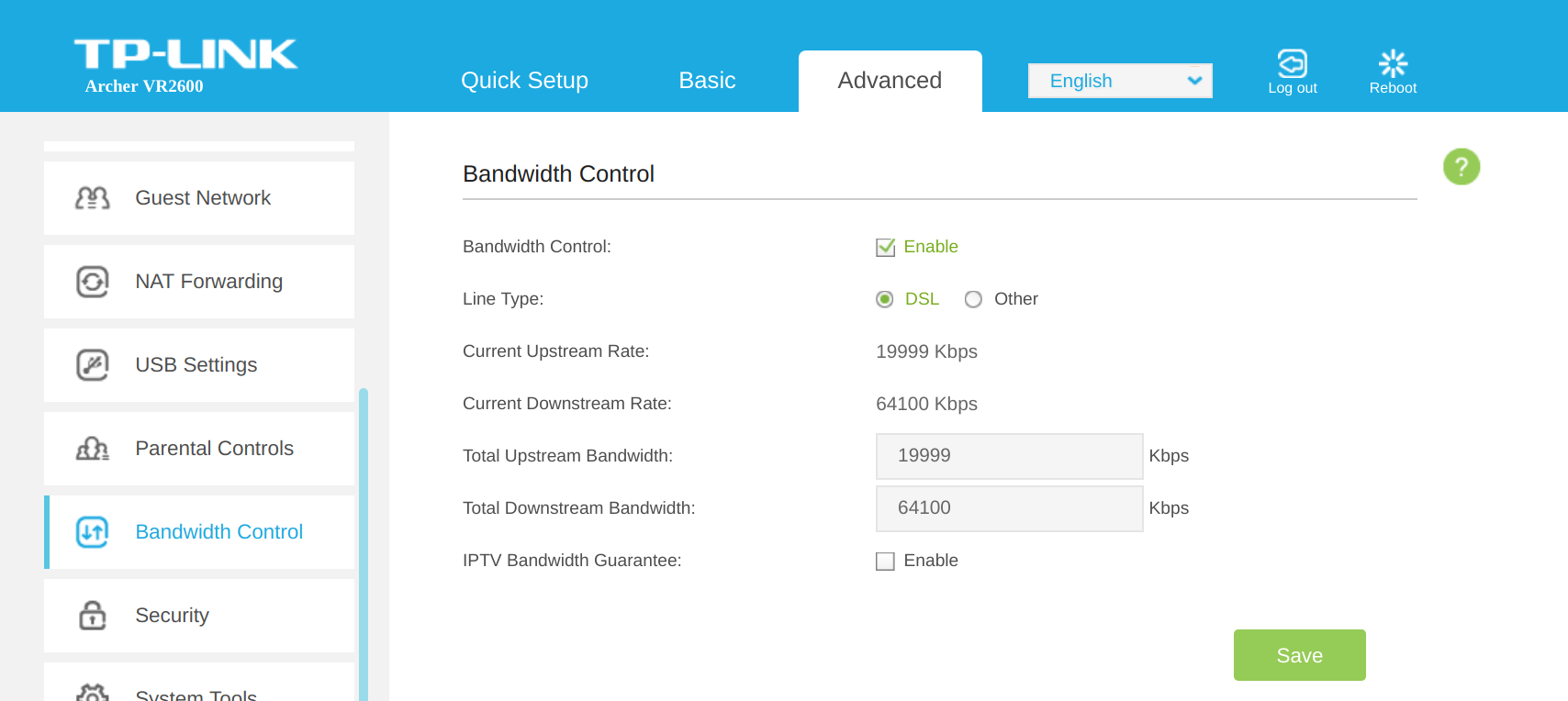
Aktivieren Sie die Bandbreitensteuerung, und dies scheint QoS zu aktivieren, was wiederum sicherstellt, dass der Router das TOS-Datagramm oder wie es auch genannt wird, den Paketkopf, respektiert.
Ich hoffe, das hilft anderen und spart einige Debug-Zeit.
TTFN,
Graham